Tear off containers sized to the roof, not the other way around. Shingles are heavy, so we size by roof size, layers, and material before you book.
A roofing tear off fills a dumpster faster than any other residential job, and it fills it with heavy material. Shingles, underlayment, flashing, and nails come off the roof in a day, and they weigh far more per cubic yard than household junk or drywall. That is why roofing dumpster rental starts with three questions: how big is the roof, how many layers of shingles are on it, and what material is it. Call (833) 748-4153 with those three answers, and we will size the container to the roof instead of guessing.
New York roofs work hard. Lake effect snow in Buffalo and Rochester, nor'easters on Long Island, ice dams in the Hudson Valley, and summer heat on city flat roofs all shorten a roof's life. The median New York home was built in 1959, and many roofs on those homes have two or even three layers of shingles, because re roofing over the old layer was common practice for decades. Each extra layer adds weight and volume, and it changes the container size. A single layer tear off on a ranch is a different job from a three layer tear off on a Victorian, and the dumpster should match the job.
| Size | Dimensions | Capacity | Included weight | Best for |
|---|---|---|---|---|
| 10 yard | 14 ft long, 7.5 ft wide, 3.5 ft tall | About 3 pickup loads | 1 to 2 tons | Small cleanout, half bath remodel, heavy debris |
| 15 yard | 16 ft long, 7.5 ft wide, 4.5 ft tall | 4 to 5 pickup loads | About 2 tons | Basement finish, deck removal, downsizing |
| 20 yard | 22 ft long, 7.5 ft wide, 4.5 ft tall | 6 to 8 pickup loads | 2 to 4 tons | Whole room remodel, roofing tear off, full cleanout |
| 30 yard | 22 ft long, 7.5 ft wide, 6 ft tall | 9 to 12 pickup loads | 3 to 5 tons | Whole home renovation, estate cleanout |
| 40 yard | 22 ft long, 7.5 ft wide, 8 ft tall | About 12 pickup loads | 4 to 5 tons | Full demolition, commercial, multi unit work |
A small roof, such as a one car garage, a porch roof, or a small ranch with one shingle layer, fits a 10 yard dumpster. A typical single family home roof with one layer of asphalt shingles fits a 20 yard dumpster, which is the standard roofing size. A large roof, or a roof with two or three layers, usually needs a 30 yard dumpster, or a 20 yard box plus a second load. Slate and tile roofs are a special case: the material is extremely heavy, so it goes in a small container, often a 10 yard box, even for a large roof. Flat roofs with built up roofing and gravel are heavy too, so call us before you book a flat roof tear off.
The honest rule is that roofing size is a phone conversation, not a chart. Roof size, pitch, layers, and material all change the answer, and a five minute call with those details beats a wrong container on tear off day. Roofing crews work fast, and a full container at noon with half a roof left to tear off is a problem nobody wants. Tell us the roof and we will size it right.
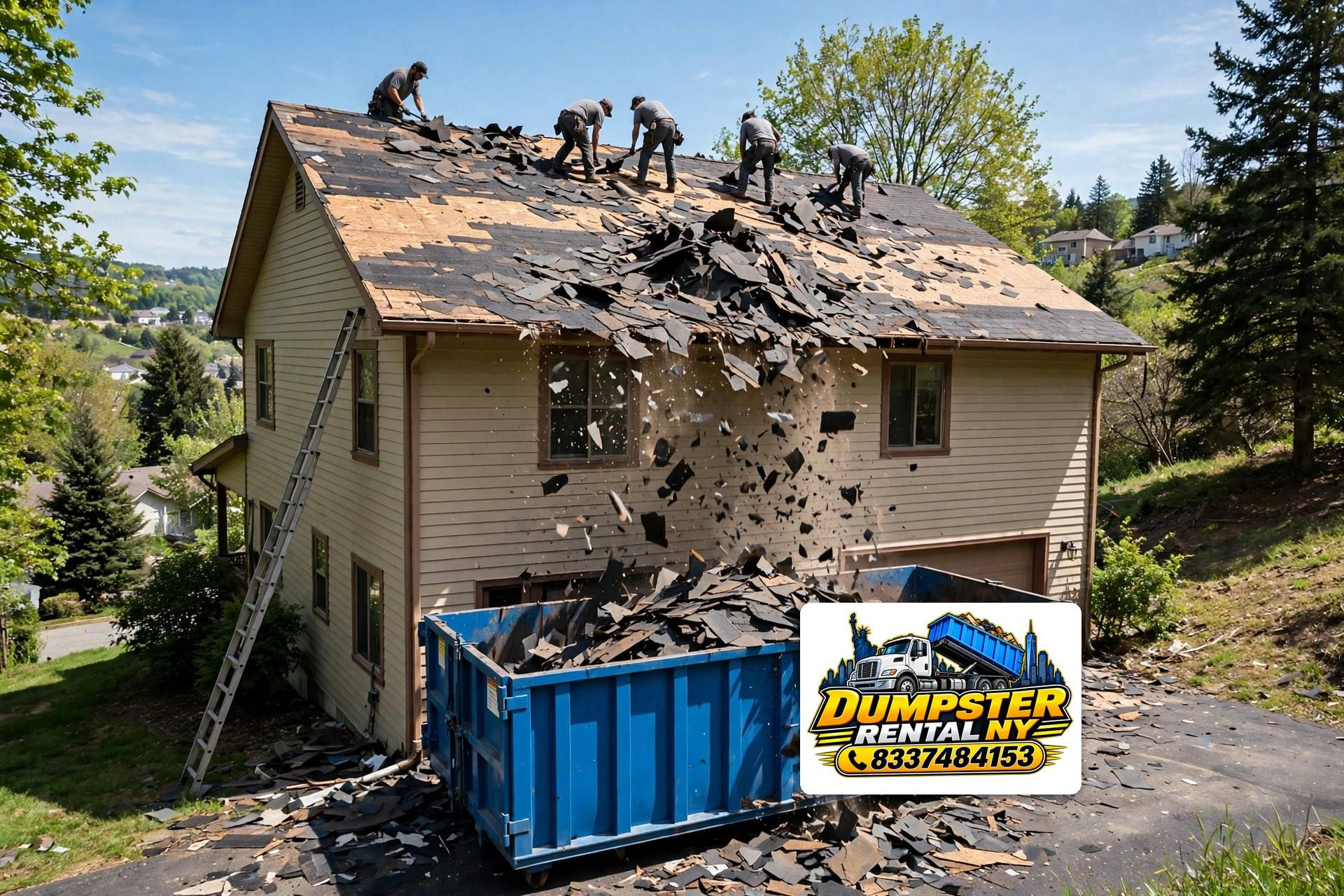
Asphalt shingle tear offs. The most common roofing job in New York. One layer of architectural or three tab shingles, plus underlayment, flashing, drip edge, and nails. A typical single family roof fits a 20 yard box. Multiple layers or a large roof step up to a 30 yard box or a second load.
Slate and tile tear offs. Slate and tile are beautiful and extremely heavy. A slate roof tear off fills a small container by weight long before it fills by volume, so the 10 yard box is the standard here, sometimes with several loads for a large roof. Call us with the roof size and we will plan the loads.
Flat roof tear offs. Built up roofing, modified bitumen, and EPDM membranes from flat and low slope roofs, common on New York City rowhouses, commercial buildings, and additions. Built up roofing with gravel is heavy, so flat roof jobs need a weight conversation before you book.
Wood shake and metal roof removal. Cedar shakes are light and bulky, so they fill by volume and suit a 20 or 30 yard box. Metal roofing is light and recyclable in many cases, so ask us about separating metal panels from the general load.
Gutters, flashing, and fascia. Gutters, downspouts, flashing, fascia boards, and soffit material removed during a roofing job all go in the same container as the shingles. Keep metal flashing separate if you can, because clean metal is easier to handle at the disposal site.
Roofing dumpster placement is about the throw. The container should sit as close to the eaves as the driver safely can, so the crew can toss shingles straight off the roof and into the box. A chute or a tarp slide helps on a steep roof, and a ground crew member keeping the load level prevents a pile from building on one side. Mention the roof line, the driveway layout, and any obstacles when you book, so the driver can place the box for the shortest throw. A box in the wrong spot means the crew carries shingles across the yard all day, and that is slow, tiring work.
Roofing tip: load the box as the tear off progresses, and keep the load level. A pile on one side wastes space and makes pickup harder. Call (833) 748-4153 to talk through placement before tear off day.
Shingles are the heavy debris of roofing, and the rule is the same as for concrete: heavy material fills a container by weight before it fills by volume. A 20 yard box of shingles from a large roof can approach its weight allowance, and a 30 yard box of shingles from a very large roof can exceed it. That is why we ask about roof size and layers before we recommend a size. Slate, tile, and gravel built up roofing are heavier still, and they belong in a small container. Never load shingles above the top rail, and never mix a large amount of concrete or brick into a roofing load. If your roofing job includes a chimney removal or a concrete element, plan a separate small container for the heavy portion.
Asphalt shingles, wood shakes, slate, tile, metal roofing panels, underlayment, felt, flashing, drip edge, gutters, downspouts, fascia, soffit, nails, and roofing packaging are all fine in a roofing dumpster. New York law keeps some items out of every dumpster, whatever the job:
Asbestos containing roofing material, including some old roofing felts and mastics, needs licensed abatement and never goes in a dumpster. If your roof is old and you are unsure about the materials, have it checked before the tear off starts. If you are unsure about a single item, call (833) 748-4153 before you load it.
A dumpster placed entirely on private property, such as your driveway, generally needs no permit anywhere in New York State. That covers most roofing jobs. A dumpster placed on a public street or in the right of way usually needs a municipal permit. In New York City, container permits are issued by NYC DOT, not DSNY, and the standard Commercial Refuse Container permit covers one container for up to 5 consecutive days, obtained by the carting company. Construction debris permits for worksites with their own construction permits run 30 to 90 days. Upstate cities run their own programs: Buffalo requires a Public Works permit applied for at least 7 business days ahead, with proof of liability insurance, Rochester requires a right of way permit, Syracuse issues right of way permits through its Central Permit Office, Albany uses a Sidewalk and Barricade Permit, and Yonkers requires an Engineering Department permit. Permit rules vary by municipality, so call us for guidance on your city before you book a street placement. And remember Dig Safely New York: call 811 before any ground disturbance.
The delivery truck needs about 60 feet of clear space to drop the container and roughly 23 to 25 feet of vertical clearance. Roofing jobs add a timing question: the container should arrive before the tear off starts, and it should be picked up as soon as the roof is done, so the crew is not working around a full box. Park cars out of the driveway, move bins and basketball hoops, and check for low wires and low branches over the drop spot. Mention tight turns, steep grades, and narrow streets when you book. The standard rental period is 7 days, and longer rentals are available, though most roofing jobs finish in a day or two. If you need a container quickly, call and ask about availability for your area and your date.
Toss shingles straight into the box from the roof where you can, and keep a ground crew member leveling the load as it builds. Load flat material like underlayment and flashing along the bottom, and keep the load level with the top rail. Never let debris stick out over the sides, and never heap above the rail, because an overloaded container cannot be picked up. Sweep up nails with a magnet when the job is done, and check the driveway and lawn before the truck leaves. If the box fills before the roof is done, call us and we can arrange a swap so the crew keeps working.
A typical single family roof with one layer of shingles fits a 20 yard box. A small roof fits a 10 yard box, and a large roof or multiple layers need a 30 yard box or a second load. Slate and tile need a small box because they are so heavy.
Yes. Shingles weigh far more per cubic yard than household junk. Roof size, pitch, layers, and material all change the weight, so call with those details and we will size the container to the roof.
Yes, but slate is extremely heavy, so it goes in a small 10 yard container, sometimes with several loads for a large roof. Call us with the roof size and we will plan the loads.
As close to the eaves as the driver safely can, so the crew can toss shingles straight off the roof into the box. Mention the roof line and driveway layout when you book.
Not if it sits entirely on private property such as your driveway. Street placement usually needs a municipal permit, and in New York City those permits come from NYC DOT, not DSNY.
The standard rental period is 7 days, and longer rentals are available. Most roofing jobs finish in a day or two, and we pick up as soon as you call.